 Esport Me
Esports explained: how prize money, teams and tournaments actually work
A breakdown of how competitive gaming is organised, from qualification paths to prize pools, as detailed by Esports.gg News.
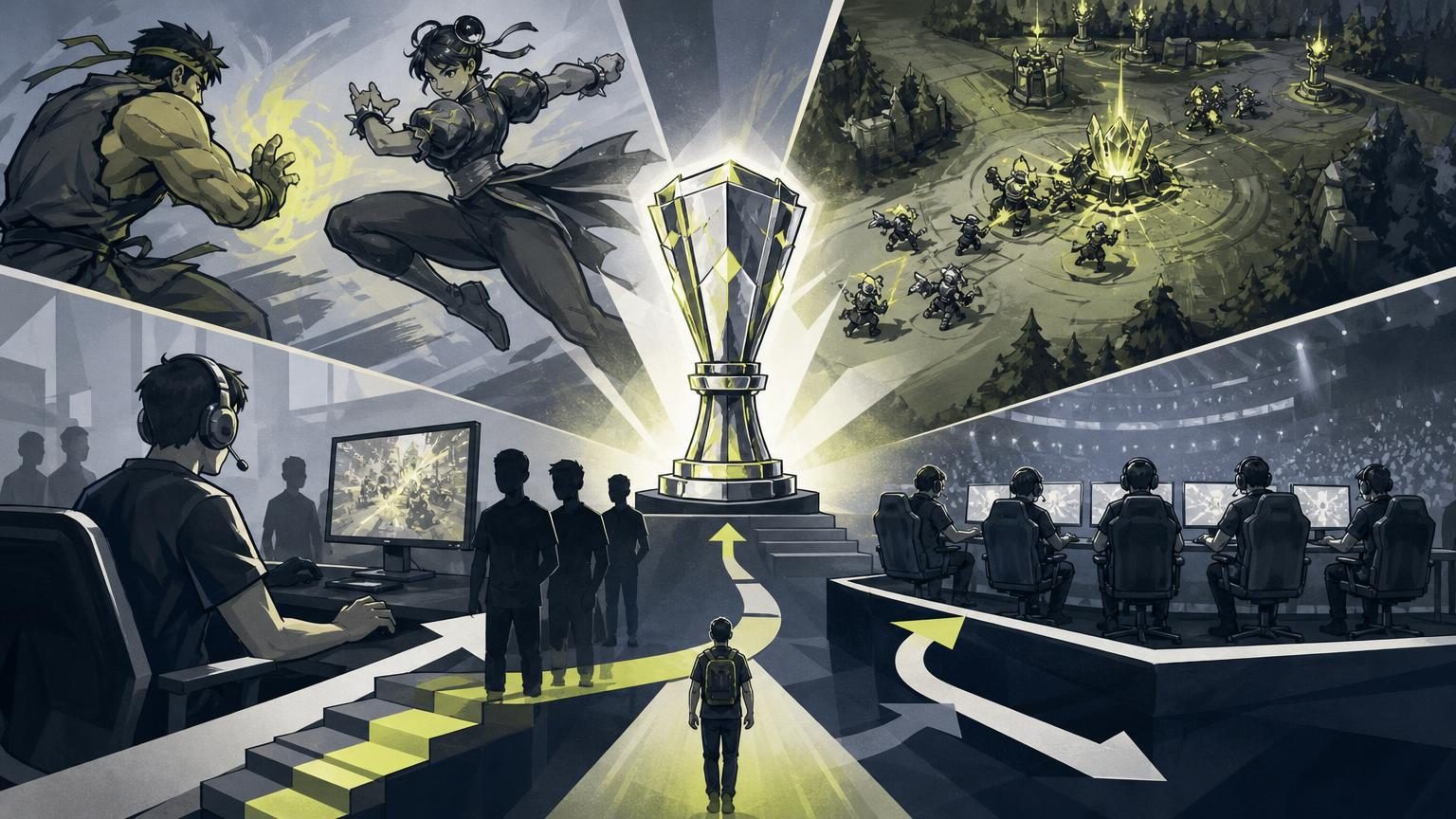
Esports describes organised competition in video games, where professional players or teams face off for prize money and recognition rather than simply playing for fun, according to Esports.gg News.
The distinction is the competitive structure. Playing League of Legends casually with friends is gaming; fighting through a bracket in a high-stakes tournament against other professionals is esports, Esports.gg News explains.
There is no single format that every title follows. League of Legends illustrates one route: teams first have to fight through regional leagues such as the League of Legends Champions Korea (LCK) 2026 Season Playoffs before they can qualify for the League of Legends 2026 Season World Championship.
World of Warcraft's Mythic Dungeon International shows a different shape entirely. The 2026 edition opened with a Time Trials phase, then split the top 24 teams, plus eight from China, into three groups of eight. Only two sides per group advanced to the Season 1 Finals, where four spots in the WoW MDI Global Finals at BlizzCon 2026 were on offer, an in-person event with a live crowd.
Prize pools vary sharply by game and genre. Esports.gg News cites the 2026 Dota 2 International at $3,906,263, LoL Worlds 2026 at $5,000,000, VALORANT Champions 2026 at $2,250,000 and the IEM Cologne Major 2026 for Counter-Strike 2 at $1,250,000. Fighting game events sit lower by comparison, with EVO Las Vegas 2026 for Street Fighter 6 offering $100,000 and the Tekken World Tour Global Finals 2025 offering $300,000.
Organisations such as T1, Team Vitality, Team Liquid and G2 Esports field rosters across multiple games rather than specialising in one, each typically backed by coaching and analyst staff alongside the players themselves, Esports.gg News notes.
Some players also get access to dedicated physical and mental conditioning support. Street Fighter 6 and Tekken 8 competitors within the Red Bull roster can use Red Bull Athlete Performance Centers, working with strength and conditioning coaches, psychologists and nutritionists.
Street Fighter 6 player Li-Wei "Oil King" Lin told Esports.gg that his preparation mirrors that of athletes in other sports. "My gym routine is like training a traditional sports player," he said, drawing a comparison with Taiwanese athletes who compete at events such as the Olympics. Red Bull also supports athletes in Apex Legends, VALORANT and FIFA, according to the outlet.
Income in esports comes from several sources beyond tournament winnings, including salaries, sponsorships, streaming revenue and merchandise sales, Esports.gg News reports.
Entry points for fans or aspiring competitors range from local tournaments and online communities to watching professional matches or pursuing roles behind the scenes, such as coaching, analysis or production, the outlet adds.