 Esport Me
Swiss, Single and Double Elimination: How Esports Tournaments Decide a Winner
A breakdown of how Swiss-system, single-elimination and double-elimination brackets actually produce a result, and why organisers pick one over another.
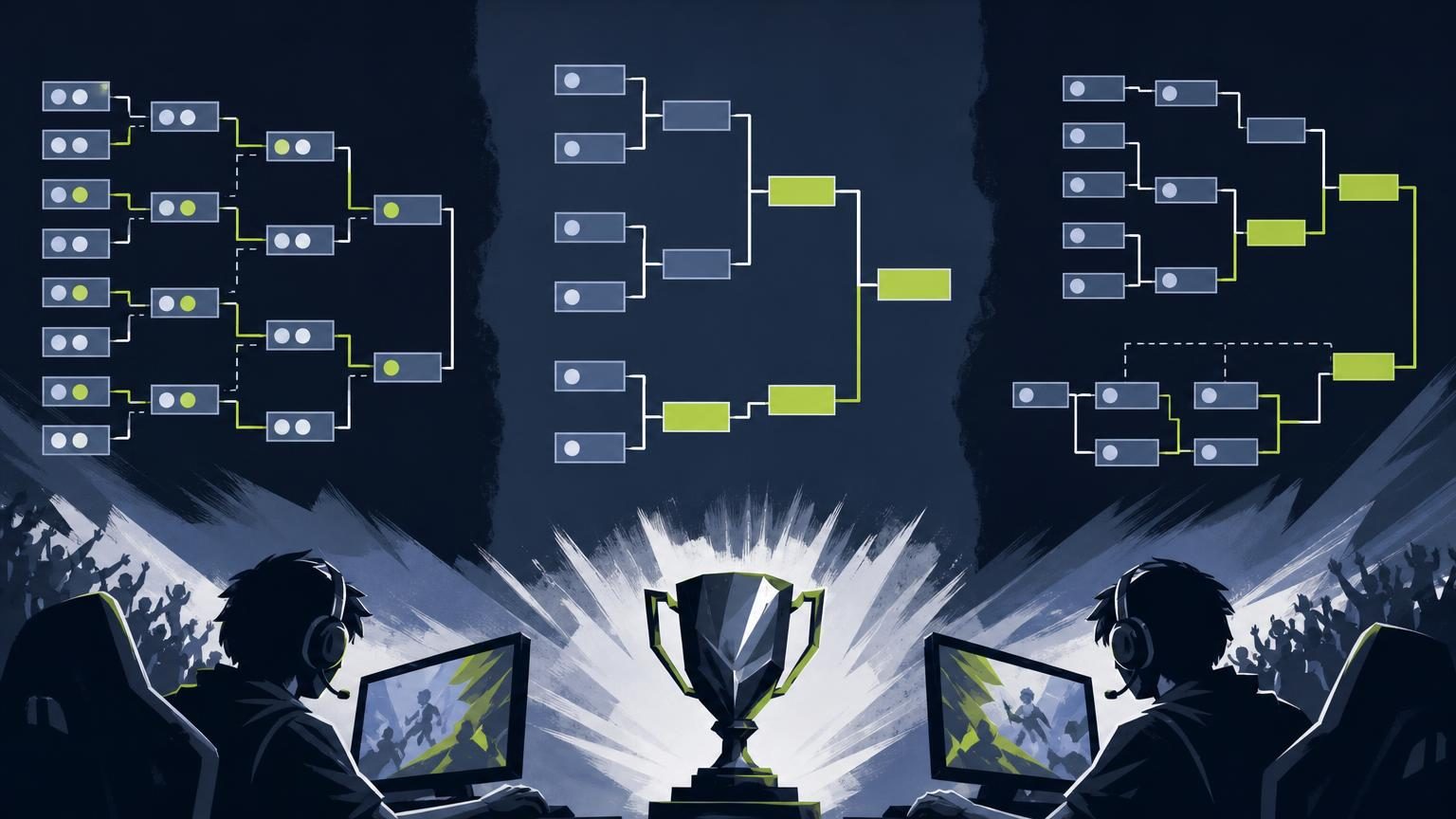
Every competitive format exists to solve the same problem differently: how to rank a field of teams fairly without forcing them to play every possible opponent. Swiss, single elimination and double elimination each strike that balance in their own way, and the choice shapes how much a single bad map or a single bad day can cost a team.
In a Swiss-system event, nobody is knocked out purely for losing once. Pairings are redrawn after every round based on each competitor's running score, so teams with matching records tend to face each other, according to Wikipedia. The number of rounds is fixed in advance, and the winner is simply whoever finishes with the best aggregate record once those rounds are complete.
That pairing logic is deliberately complex. Organisers must stop any two teams meeting twice and avoid handing anyone an accidental scheduling advantage, which is why computer software usually handles the draw rather than a human bracket-maker, Wikipedia notes.
Esports has adapted the format further. Instead of every team playing an identical number of matches, competitors keep playing until they hit a set number of wins or a set number of losses, at which point they either advance or are eliminated, per Wikipedia. This win-or-loss-count version was first used by ESL for Counter-Strike: Global Offensive qualifying ahead of ESL One Cologne 2016, and Valve's Major Championships have used the Buchholz tie-break system within this structure since PGL Major Stockholm 2021.
Single elimination is the simplest version of a bracket: one defeat and a team is out. It needs the fewest matches of any format to reach a champion, which is exactly why it suits tight schedules, but it carries the obvious risk that a strong team can be removed by one off night with no chance to recover.
Double elimination softens that risk by requiring two losses, not one, before a team is finished. Wikipedia describes the standard method as splitting the field into an upper bracket and a lower bracket: first-round winners stay in the upper bracket, while first-round losers drop into the lower bracket rather than leaving the event outright.
The upper bracket then runs like a single-elimination ladder, except that anyone beaten there falls into the lower bracket instead of being eliminated completely. A team is only out once it has lost there too. With the typical field size of a power of two, the format needs one or two fewer matches than double the number of teams involved.
Many esports tournaments, The International among them, adapt that structure further by starting with a group stage, then seeding the weaker group-stage finishers straight into the lower bracket rather than making everyone begin in the upper bracket, Wikipedia explains. The final is also usually played as one series regardless of which bracket the finalists came from, with no second, reset series if the lower-bracket side wins.
That trims the schedule considerably, since long esports series can run well over an hour per match and a traditional double-elimination format with a possible bracket reset adds real time to an event. The trade-off is scheduling balance: upper-bracket teams are often given lighter schedules and more rest, while lower-bracket teams can be made to play extra series on the tournament's final day, according to Wikipedia.
Formats keep evolving within esports specifically. Wikipedia records that in 2026 the Valorant Champions Tour introduced a third bracket into its International Leagues Kickoff stage, sitting below the usual winners' and losers' brackets to catch teams that have already dropped a game out of the losers' side before they are eliminated outright.
None of these systems removes the core trade-off: fewer rounds and a smaller bracket always mean less margin for error for the competitors inside it, while fairer, longer formats cost organisers time and scheduling complexity in return.