 Esport Me
How the League of Legends World Championship actually works
A breakdown of how teams reach Worlds through their regional leagues, and how the tournament's format has changed since 2011, according to Wikipedia's record of the event.
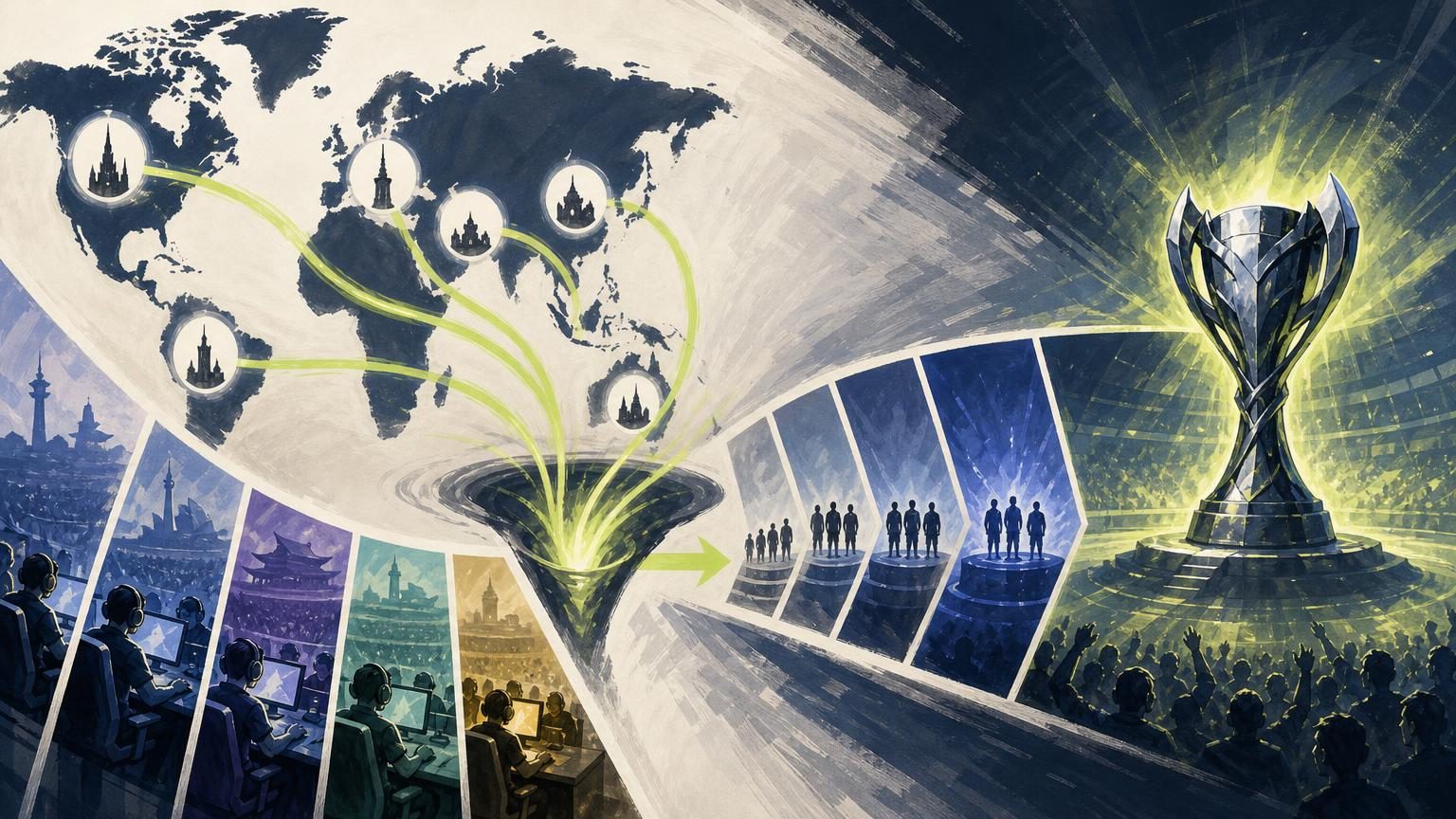
The League of Legends World Championship, known across the scene as Worlds, is the tournament Riot Games stages at the end of each competitive season to crown a single global champion. The winning team lifts the Summoner's Cup and takes a share of a championship prize pool, according to Wikipedia.
Qualification does not run through one open bracket. Riot operates more than a dozen regional leagues worldwide, each running two seasonal splits per year. Teams accumulate championship points across those splits, and those points determine which sides earn a route to Worlds and to the season's other major international event, the Mid-Season Invitational, Wikipedia states.
That structure has not stayed fixed. At the first Season 1 Championship in June 2011, only eight teams took part, drawn from Europe, North America and Southeast Asia, competing for a US$100,000 prize pool. By the Season 3 World Championship in 2013, the field had grown to 14 teams spanning North America, Korea, China, Southeast Asia, Europe and an emerging territory slot, each having come through its own regional qualifiers before meeting at the World Playoffs.
Why the Mid-Season Invitational matters here
After the 2014 season, Riot expanded the North American and European Championship Series from eight teams to ten apiece and introduced the Mid-Season Invitational, first held in May 2015. MSI sends one team from each major region plus an international wildcard, and strong results there feed into a region's standing and points totals heading into Worlds. From 2015 onward, Riot also required every team to field a head coach who could communicate with players during the pick-and-ban phase, formally recognising coaches as part of the competitive roster.
The play-in era and the Swiss stage
Twenty-four teams qualified for the 2022 World Championship, each slotted in according to its regional league placement and the region's recent international results, before the finals at the Chase Center between T1 and DRX. DRX's run through the play-in stage to the title was notable precisely because no team had previously won Worlds after starting from that bottom tier, Wikipedia notes.
The format shifted again for 2023. Twenty-two teams qualified, mostly through regional placement, but one side came through a newly introduced Worlds Qualifying Series contested between the fourth seeds of the LEC and LCS. The event itself restructured into three stages: an eight-team play-in split into two double-elimination brackets, from which three teams advanced into a Swiss-system stage alongside 13 others, and a single-elimination knockout bracket to decide the champion. T1 beat Weibo Gaming 3–0 in that final, extending their own record for championships won.
By 2025, Riot had reorganised League's competitive map into five regions — Americas, EMEA, Korea, China and Asia-Pacific — with three teams from each qualifying for Worlds on top of the MSI qualification slots, producing a 17-team field. A single best-of-five play-in match preceded the Swiss stage. That edition also introduced Fearless Draft to Worlds: once a champion has been picked by either team in a series, it becomes unavailable to both sides for the rest of that series. Riot had originally meant to limit Fearless Draft to the first half of the season but extended it through MSI and Worlds after what the company called "overwhelming" positive feedback from its earlier use.
The trophy has changed shape too
The Summoner's Cup itself has been redesigned more than once. Riot specified an original target weight of 70 pounds, though the finished cup was made lighter so it could actually be lifted. A partnership with Tiffany & Co. produced a new 44-pound design in 2022, before a further 2025 redesign cut the weight to 22 pounds and returned the cup closer to its original look, according to Wikipedia.
Across these changes, the underlying mechanism has stayed consistent even as the numbers around it moved: regional leagues generate championship points across two splits, those points and international results decide which teams and how many reach Worlds, and the tournament's own internal stages — play-ins, Swiss, knockout — have been added and rearranged to accommodate a growing and shifting set of qualifying regions.